
The Three 'Top of Google' Spots — and Why They're Not the Same Thing
We get a version of the same question almost every week: "Can you get me to the top of Google?" Usually the tradesperson asking has seen a competitor's name sitting above theirs on a search and wants to know what it costs to get there. The honest answer is: it depends which "top" you're talking about, because there are three completely different positions above the organic results — each with its own mechanics, its own costs, and its own eligibility rules.
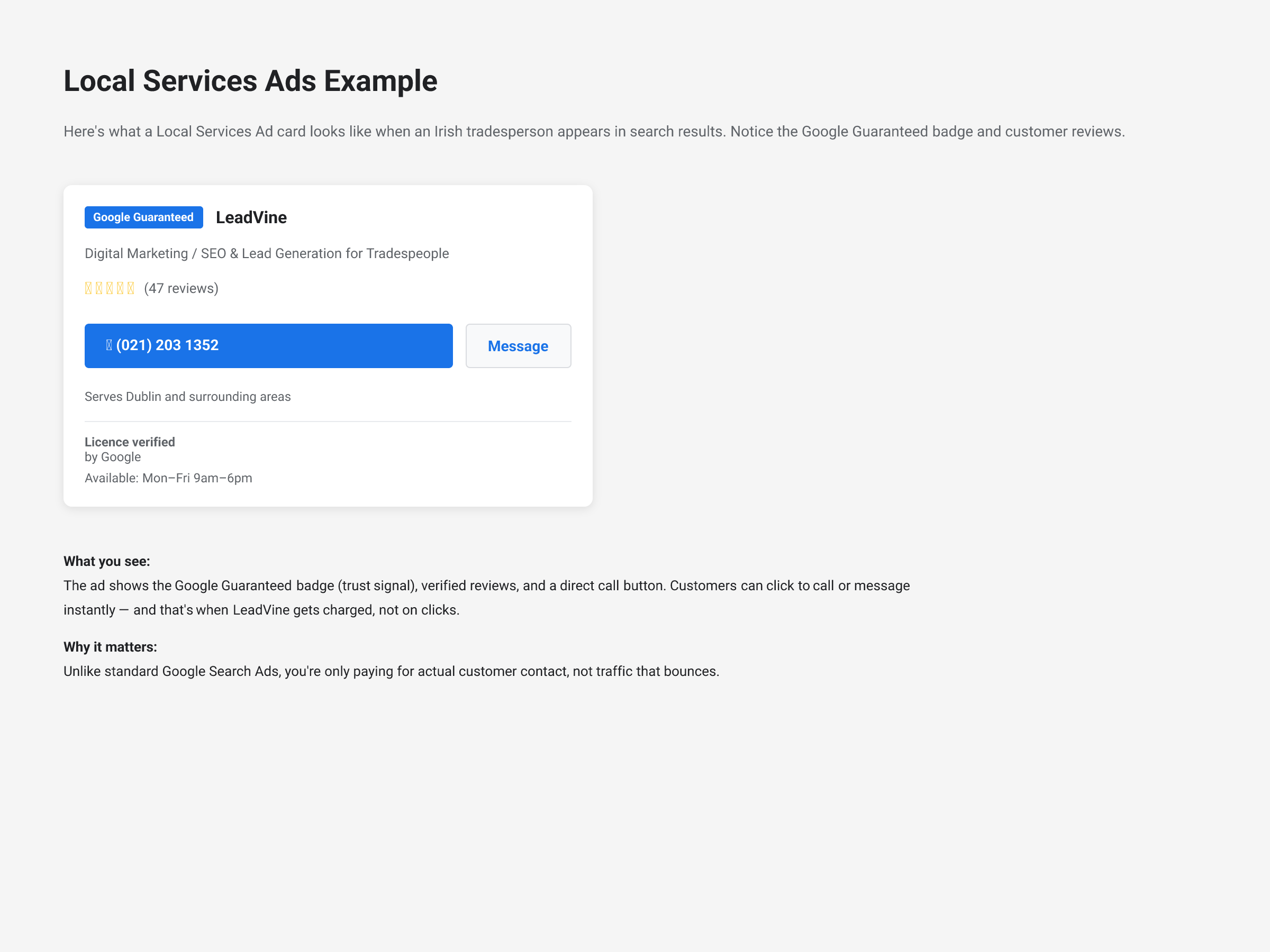
At the very top of a relevant Google search you'll often see a block of Local Services Ads (LSAs). These show a business name, a review score, a phone number, and a green "Google Guaranteed" badge. Directly below that, you may see standard Google Search Ads: the familiar blue headline links marked with a small "Sponsored" label. Then, further down, sits the Map Pack: a cluster of three local businesses shown on a small map, with star ratings and a link to their Google Business Profile. These are organic results. No ad spend puts you there.
All three can appear on the same page at the same time. A user searching "plumber Cork" or "electrician Dublin" might scroll past all three before reaching the standard organic results. Each position targets a different type of searcher, involves a different type of cost, and rewards a different set of signals. Treating them as the same product is one of the most expensive mistakes a trades business can make.
What Local Services Ads Actually Are (And the Google Guaranteed Badge Explained)
Local Services Ads are Google's purpose-built product for service businesses. Unlike standard Search Ads, you don't pay per click. You pay per lead — meaning you're charged only when a potential customer contacts you directly through the ad by phone call or message. That's a meaningful distinction. You're not burning budget on users who click and bounce; you're paying for actual enquiries.
The green "Google Guaranteed" badge that appears alongside your LSA listing is the most visible trust signal Google offers to local businesses. It tells the searcher that Google has verified the business behind the ad. It's not just a logo you can turn on. To earn it, your business has to pass Google's verification process, which we'll cover in the next section. That badge carries genuine weight with customers, particularly for high-stakes jobs like boiler replacements, electrical rewires, or roof repairs where trust is the deciding factor.
Because LSAs sit above both Search Ads and the Map Pack in most results, they occupy the most valuable screen real estate on a local search. For qualified tradespeople, they represent the strongest possible paid presence on Google — provided your profile has the reviews to rank well.
What You Need to Qualify for LSAs as an Irish Tradesperson
This is where many tradespeople hit a wall. You cannot simply open a Google Ads account and switch on Local Services Ads. There is a structured verification process, and Google will not approve your listing until every required element is confirmed.
First, you need a claimed and verified Google Business Profile. This is the foundation everything else is built on. If your profile is unclaimed, unverified, or has incorrect information, the LSA application process stalls before it starts. Second, you'll need to provide proof of valid business insurance. The specific requirements vary by trade, but public liability cover is typically the baseline. Third, depending on your trade, Google may require evidence of relevant trade registration or licensing — for example, RECI registration for electricians or RGII registration for gas installers in Ireland. Fourth, Google requires background checks on the business owner and, in some cases, on employees who carry out the work.
Availability is also worth flagging. LSAs have rolled out more gradually in Ireland than in the US or UK, and trade category availability is not universal across all Irish locations. We work with our clients to confirm eligibility before starting an application, because the timeline to get verified can run to several weeks. Getting everything in order upfront is the difference between going live quickly and sitting in a verification queue for a month.
If you're not sure whether your trade qualifies, Google's LSA eligibility page is the most up-to-date source to check against.
How LSA Ranking Works: Why Reviews Beat Budget
Once you're approved and live on LSAs, the natural next question is: how do you rank higher than competitors? The answer surprises most tradespeople, because it has very little to do with how much you're spending.
Google's LSA ranking algorithm weights review count and review recency heavily. A plumber with 90 verified Google reviews, responding to leads promptly and maintaining a strong response rate, will rank above a competitor bidding twice as much per lead but sitting on 15 reviews from three years ago. Budget matters at the margins — setting your weekly budget too low can limit how often your ad shows — but it is not the primary lever.
This has a practical implication: building your LSA ranking is a long-term process that starts with your Google Business Profile reviews, not your ad account. We always advise clients to get a solid review base in place before launching LSAs, because launching with a thin review profile means paying for leads while ranking poorly — the worst of both worlds. Responsiveness also feeds into ranking. Google tracks how quickly you respond to messages and calls placed through LSAs. Slow response rates will push your listing down. The platform rewards businesses that treat every lead like it matters, because to Google, that's a signal of a quality provider.
Google Search Ads: The Most Accessible Paid Option
For tradespeople who either don't qualify for LSAs yet, or want to be visible for a broader set of search terms while building their LSA profile, Google Search Ads are the most accessible route to paid visibility on page one.
Search Ads work on a pay-per-click model. You bid on keywords — "emergency plumber Dublin", "flat roof repair Cork", "RECI electrician Galway" — and your ad shows when someone searches for those terms. You pay when they click through to your website. The position your ad appears in is determined by a combination of your bid amount and your Quality Score, which Google calculates based on the relevance of your ad, the expected click-through rate, and the quality of your landing page.
The key trade-off with Search Ads is that they carry no Google Guaranteed badge. A searcher sees a "Sponsored" label and your ad copy. That's it. They have no in-platform verification signal from Google. This doesn't make Search Ads ineffective — far from it. A well-structured campaign for the right trade in the right location can generate a strong, consistent flow of enquiries. But it does mean your ad copy and your website need to do more of the trust-building work. For our website design clients, we align the landing page directly with the search intent of the keywords being targeted, which has a measurable impact on both Quality Score and conversion rate.

The Map Pack: The One Spot You Can't Simply Buy
The Map Pack is the three-business cluster that appears on local searches, showing a small map thumbnail, a business name, star rating, address, and a link to the full Google Business Profile. It appears below the paid ads and above the standard organic results on most local searches. For many trades queries, it's the first thing a user actually stops to read.
You cannot purchase a Map Pack position. There is no ad product that puts you there. Google's algorithm determines which three businesses appear based on a combination of relevance, distance from the searcher, and prominence. Prominence is where the work happens: it's shaped by the quality and completeness of your Google Business Profile, the number and recency of your reviews, citations across the web, and the broader SEO signals from your website.
For Irish tradespeople, this means Map Pack visibility is earned over time, not switched on overnight. Consistent effort on your Google Business Profile — accurate business categories, regular posts, responding to every review, uploading job photos — compounds into stronger rankings. It also means that a competitor can't outspend you out of the Map Pack. If your profile is stronger and your reviews are better, you rank higher. That's the most durable form of Google visibility there is, and it's one we actively build for our clients alongside any paid activity.
Which Option Is Right for Your Trade Business?
The honest answer is that the best-performing trades businesses we work with don't choose just one. They run a joined-up strategy where each channel plays a specific role. But if budget or timing requires prioritisation, here's how we think about it.
If you're eligible for LSAs and have at least 20 to 30 recent Google reviews, LSAs should be your first paid priority. The pay-per-lead model is more efficient than pay-per-click for most trade jobs, and the Google Guaranteed badge gives you an immediate trust advantage at the top of the page. Start building your review count before you go live, and treat LSA lead response as urgently as a customer call.
If you're not yet LSA-eligible, or you're targeting a wider range of keywords than LSAs cover, Search Ads fill the gap. Run tightly targeted campaigns focused on high-intent keywords in your service area. Avoid broad match keywords that burn budget on irrelevant searches, and make sure the page users land on after clicking is built to convert.
In parallel with either paid option, invest consistently in your Google Business Profile and local SEO. Map Pack visibility generates calls at zero cost per lead, and once earned, it's far more stable than any paid campaign. The tradespeople who dominate their local area on Google aren't relying on one channel. They're visible in the LSA block, the Search Ads, and the Map Pack simultaneously, and that level of visibility is what we focus on building for our clients across the UK and Ireland.