The business
Dylex Drainage & Plumbing has cleared blocked drains across Dublin, Kildare, Meath and Wicklow since 2006. Engineers on call around the clock, ISO 9001 and ISO 14001 certified, most blockages cleared on the first visit.
They came to us with a website that was less than 18 months old and already working against them.
The job had five parts. The website, which is most of what follows. The Google Business Profile, which is what a lot of people see instead of a website. The Google Ads account, which the owner had already switched off. Call tracking, so a phone call can be traced back to what paid for it. And the printed material the engineers hand over on the doorstep.
The website
Where the old site got in the way
The old site was WordPress. It was not broken and it was not ugly. It was just built the way a lot of trade websites get built, which is page by page, with each new service and each new county bolted onto whatever was there before.
Three things followed from that.
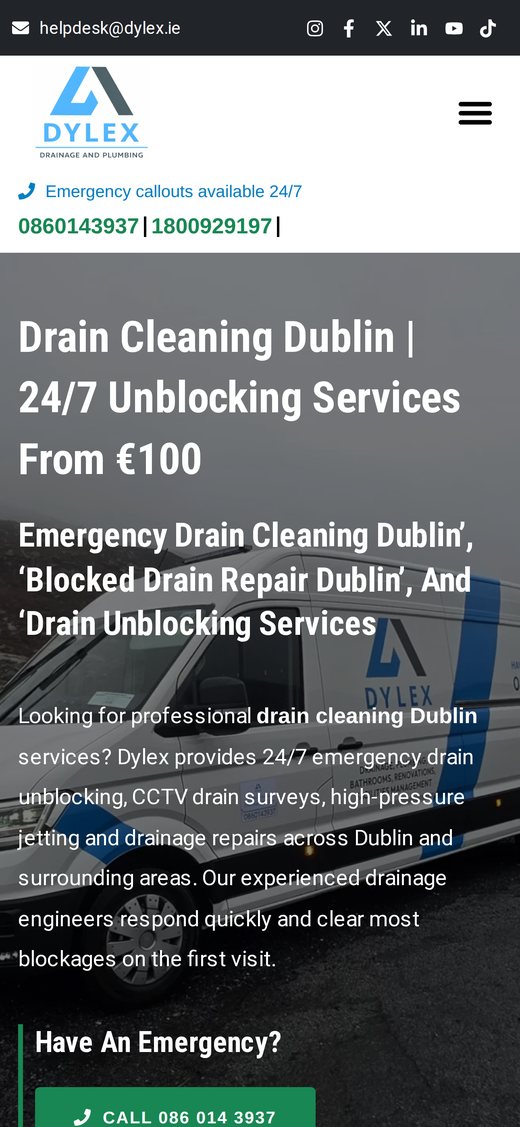
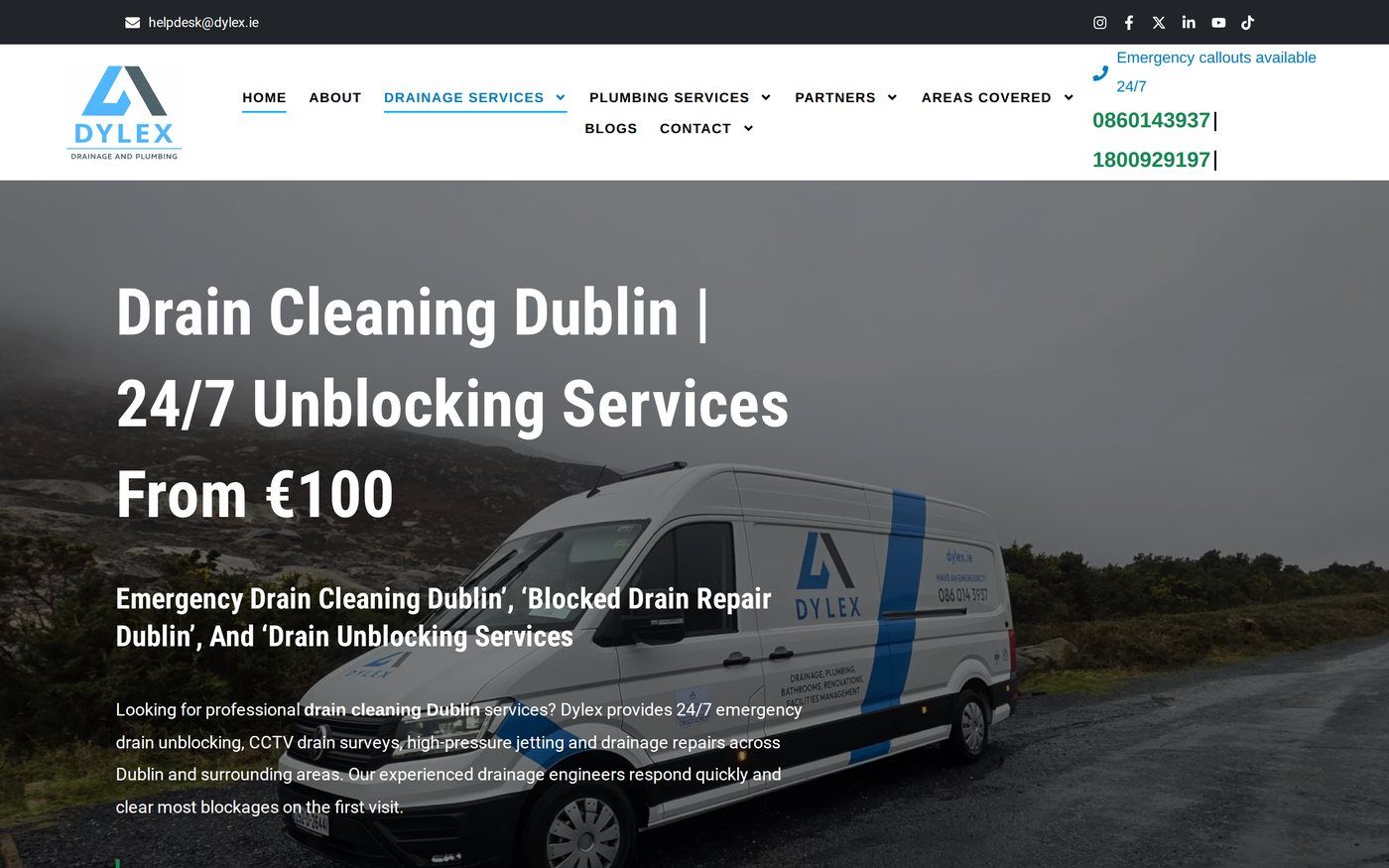
The homepage went on forever. On a phone it ran to 31,194 pixels. That is roughly 33 full screens of scrolling before you reach the bottom. Someone standing over a drain that is backing up does not scroll 33 screens.
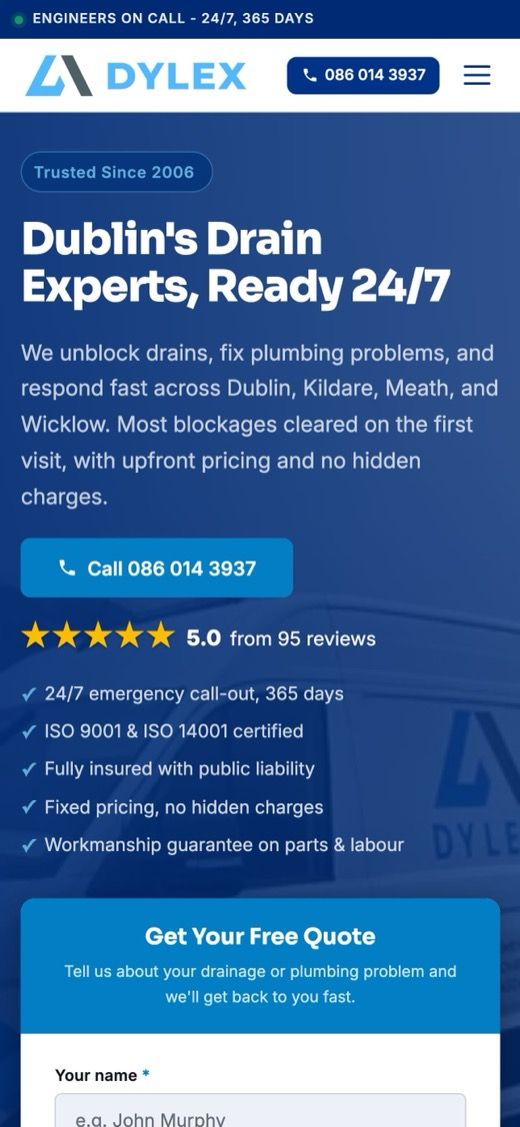
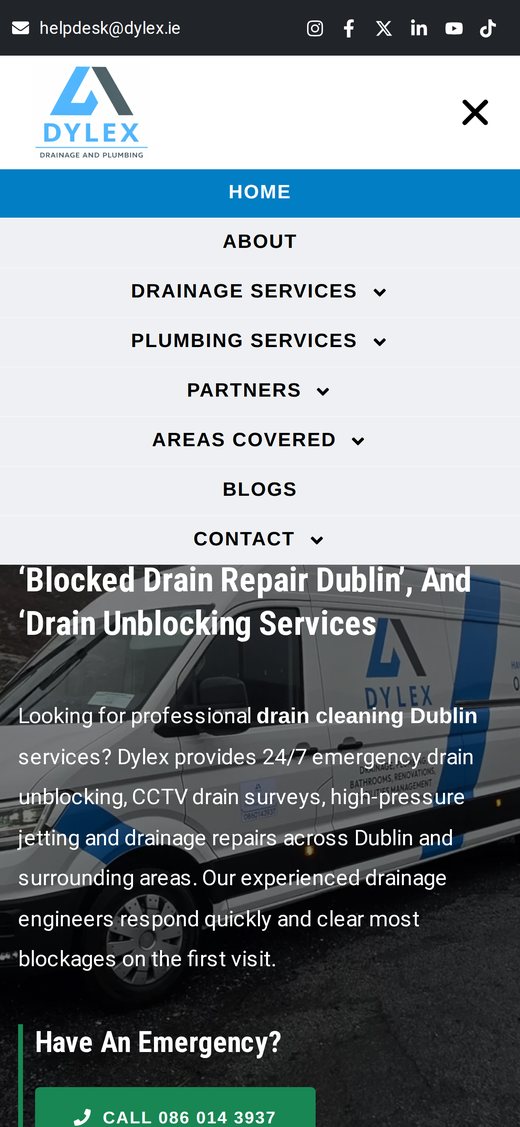
The menu asked visitors to make a decision they could not make. Eight top level items, several with dropdowns, split across two rows: Home, About, Drainage Services, Plumbing Services, Partners, Areas Covered, Blogs, Contact. A customer with a blocked drain does not know whether that is drainage or plumbing. They just want someone to answer the phone.
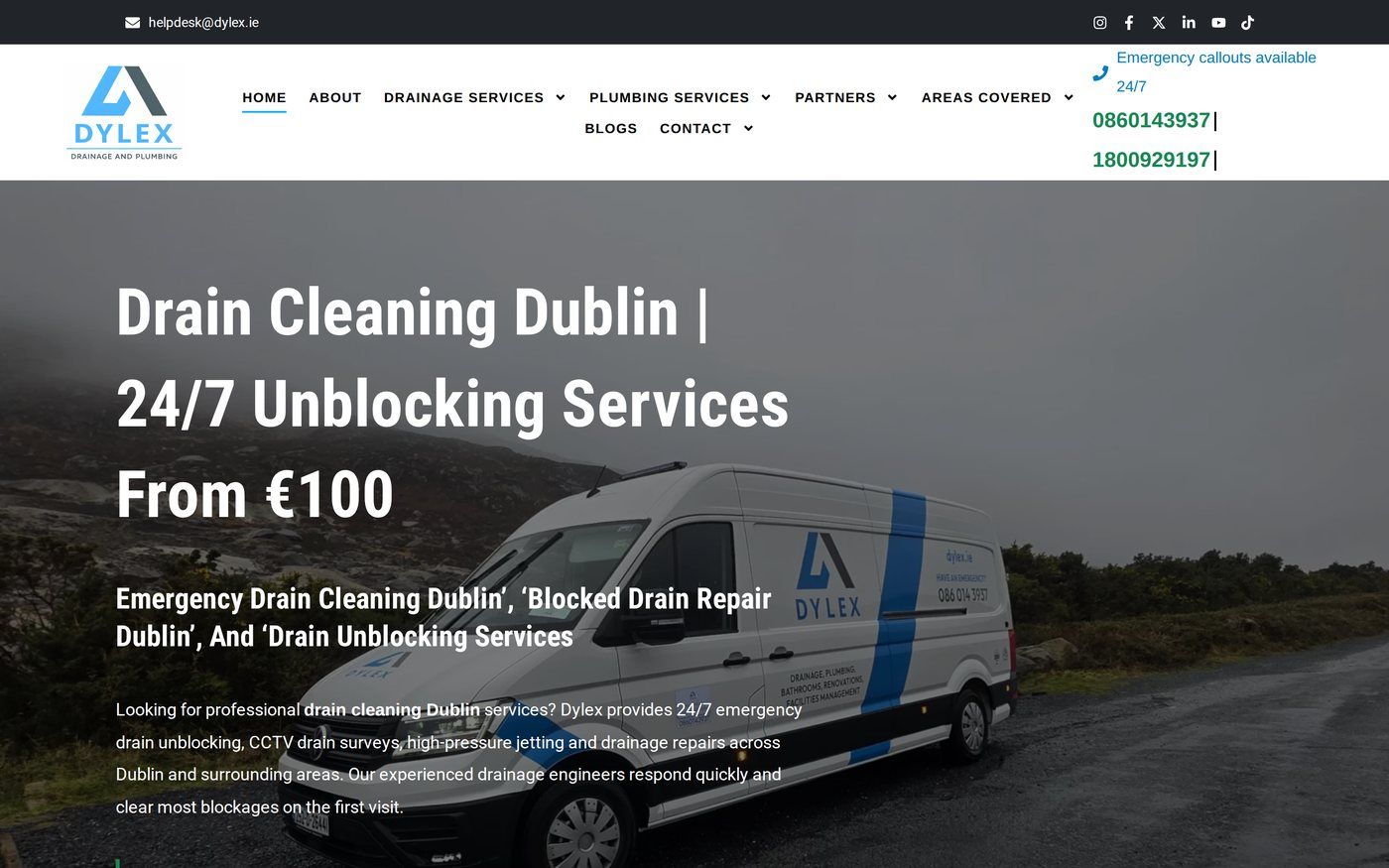
There was no way to enquire without leaving the page. The old homepage put a phone number in the header and nothing else above the fold. Every enquiry depended on the visitor deciding to dial.
Homepage, Desktop
Before
After
What we changed
A homepage you can finish
The new homepage is 8,429 pixels on desktop and 11,457 on mobile. That is 56 percent shorter on desktop and 63 percent shorter on mobile.
Nothing useful was thrown away. The length came out of repetition, stacked hero images and paragraphs that said the same thing three times in different words.
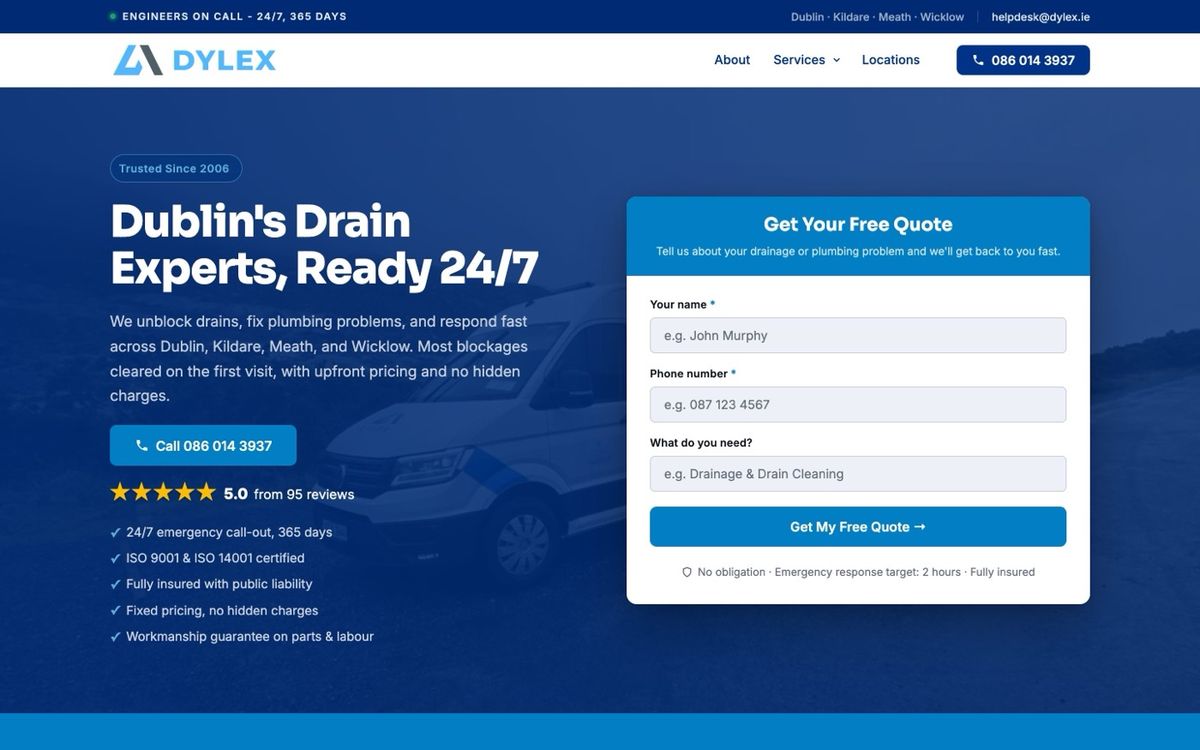
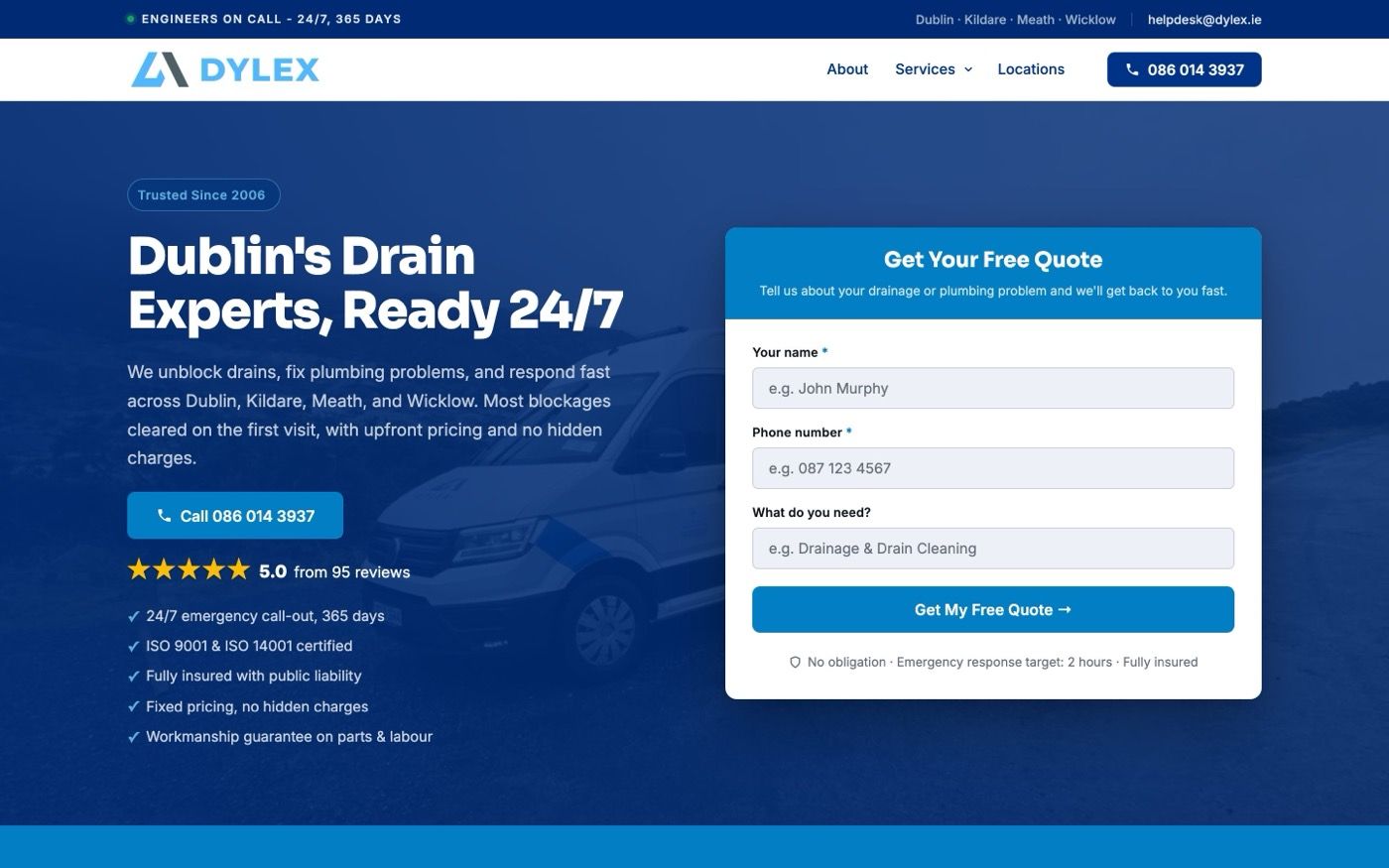
Above the fold there is now a quote form, a call button, the review score and five things a customer actually wants confirmed before they call: available 24/7, certified, insured, fixed pricing, work guaranteed.
Homepage, Mobile
Before
After
Side by side at the same scale, both homepages end to end. Nothing makes the point better than seeing where each one stops.

Eight menu items down to three
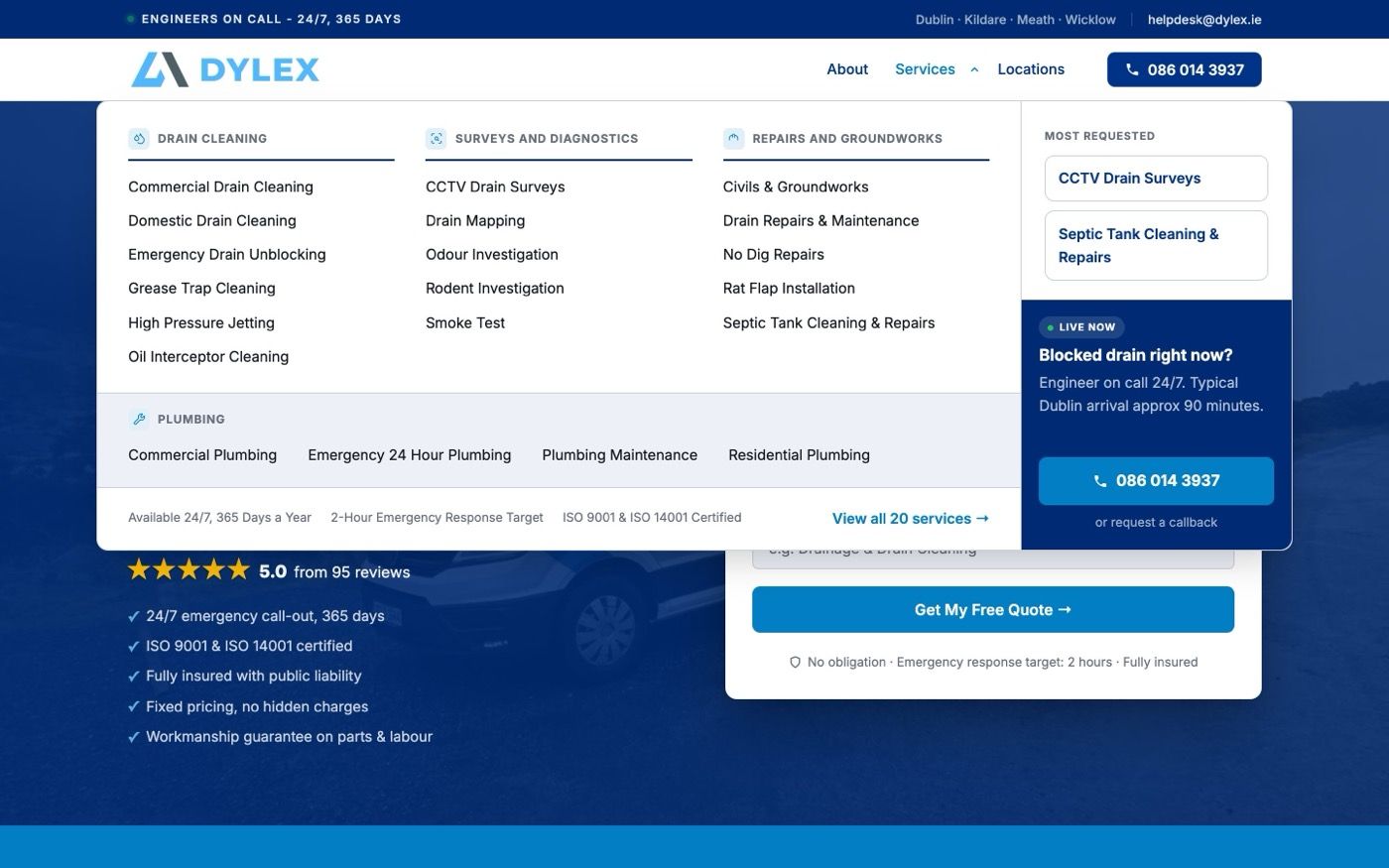
The new menu is About, Services and Locations, with the phone number as a button beside it.
Services opens a panel that lays out all 20 services in four groups, with the two most requested jobs pulled out separately and an emergency call prompt in the corner. Everything the old menu hid behind two dropdowns is now visible in one look.
Main navigation, Desktop
Before
After
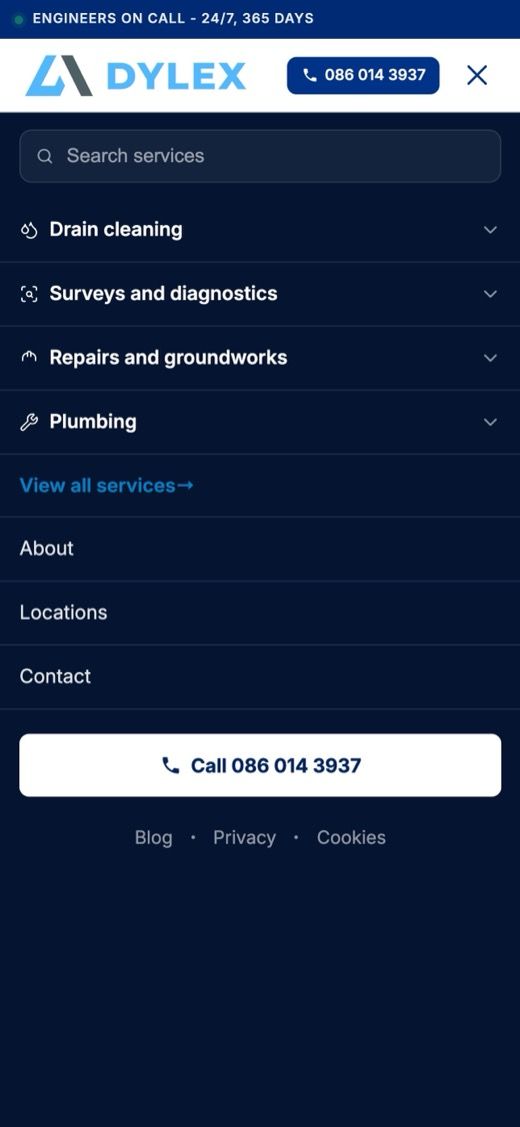
On a phone the same panel becomes a drawer with a service search box, which matters more than it sounds. Most people arriving on a drainage site are not browsing. They know the words for their problem.
Menu, Mobile
Before
After
Shorter homepage, longer service pages
This is the part that surprises people, so it is worth being clear about it.
The homepage got much shorter. The service pages got substantially longer. The Commercial Drain Cleaning page went from 3,953 pixels to 7,409, an increase of 87 percent. CCTV Drain Surveys grew by 80 percent. Emergency Drain Unblocking by 59 percent.
That is deliberate. A homepage is a signpost and it should be quick to read. A service page is where someone decides whether you are the right company for a specific job, and where Google works out what you actually do. Those pages earn their length.
Service page, Desktop
Before
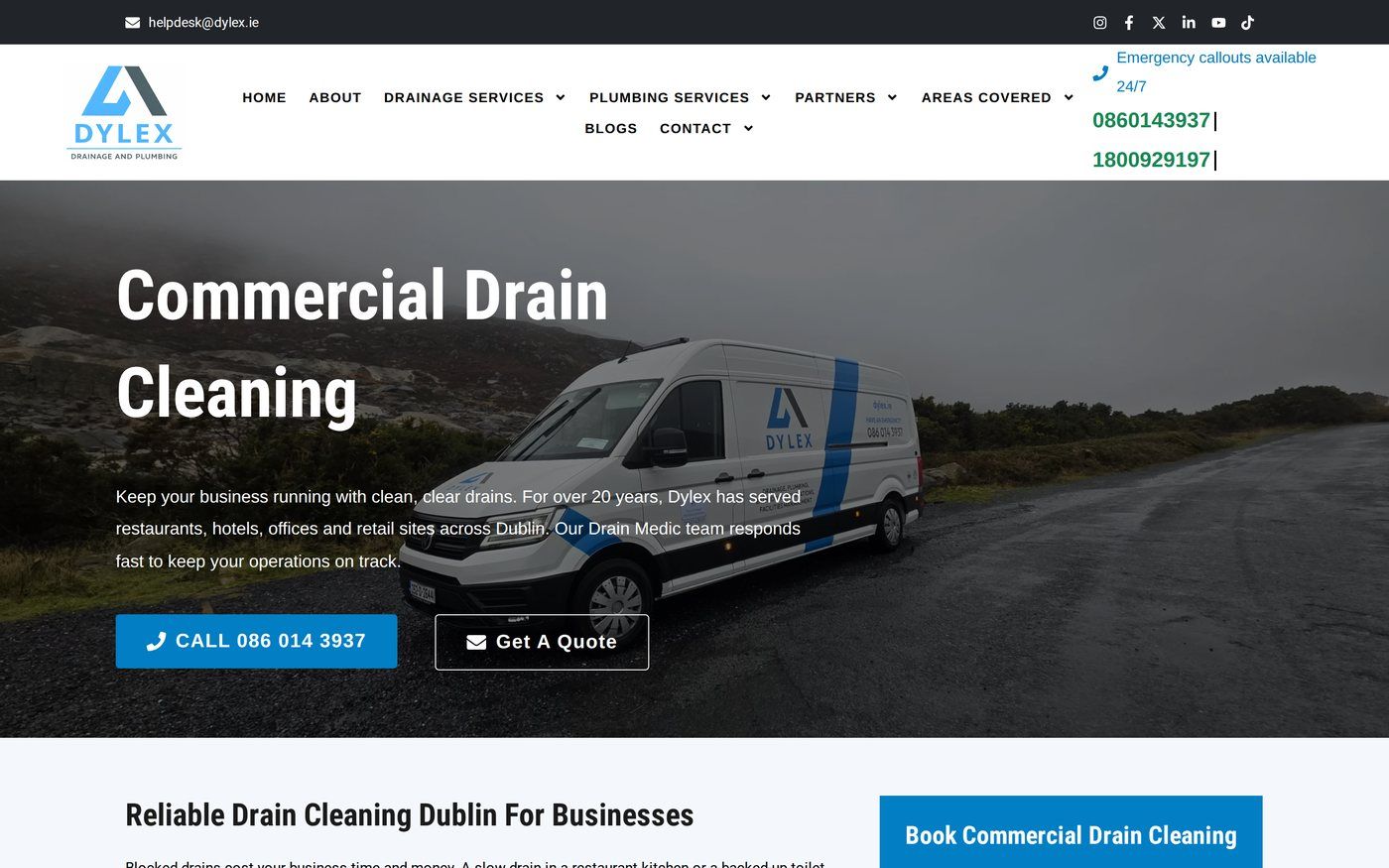
After
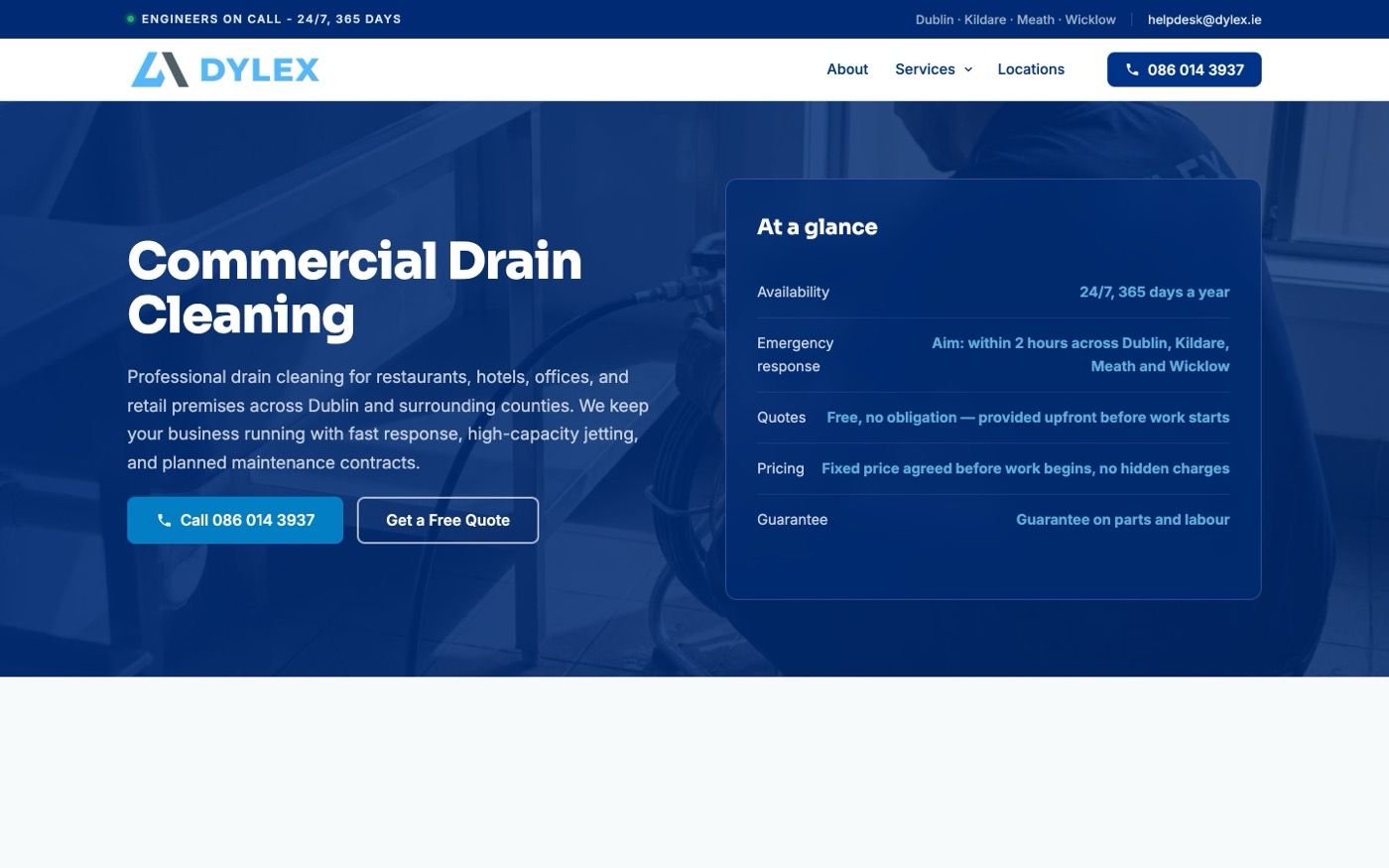
Somewhere for the service area to live
The old site had 19 service pages and eight area pages, and no page that listed either of them. There was no locations page, no about page and no contact page, and all three of those addresses returned a 404. The services address existed only to bounce visitors back to the homepage.
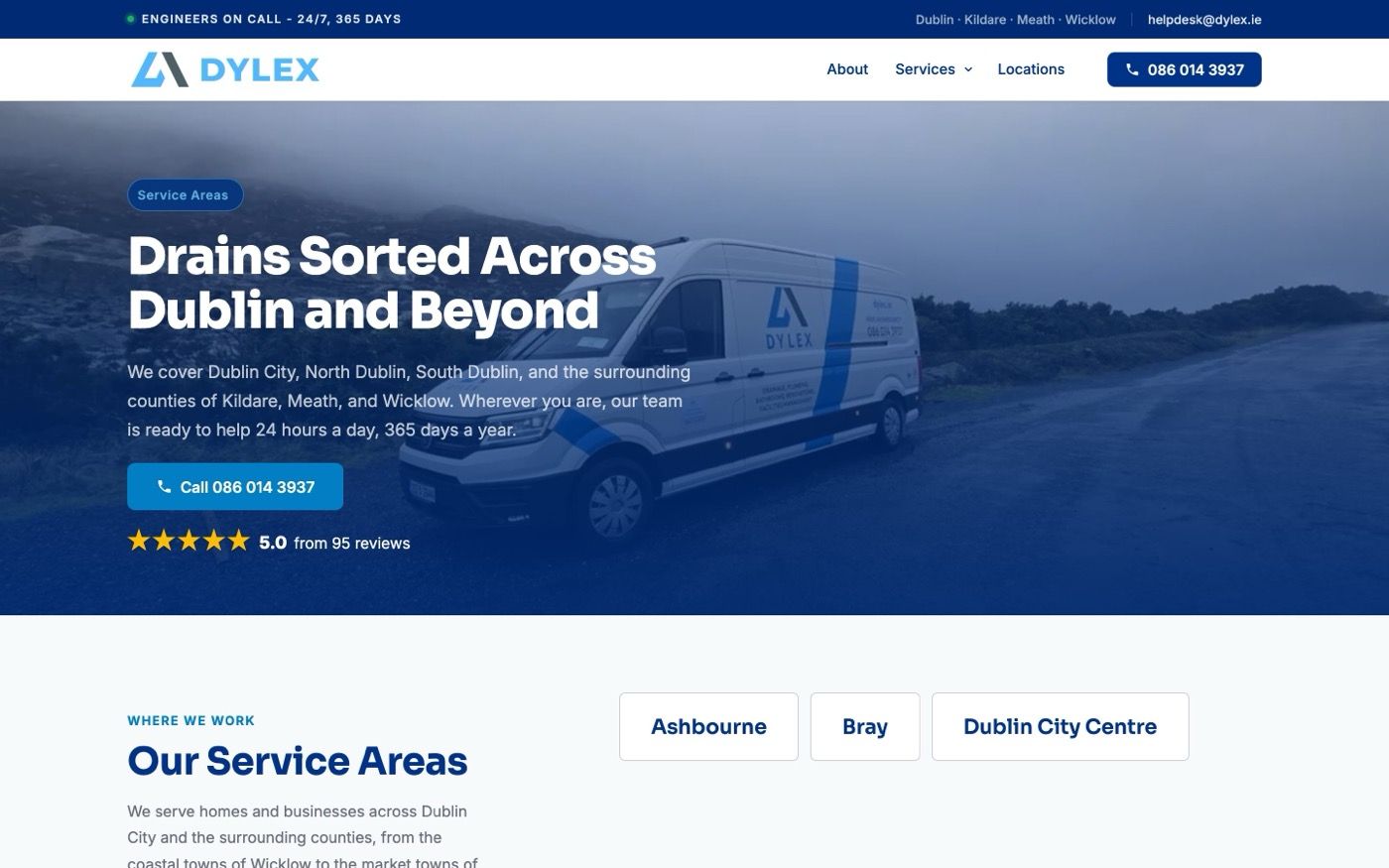
The new site has all four, plus 20 service pages and 10 location pages covering Ashbourne, Bray, Dublin City Centre, Greystones, Naas, Navan, Newbridge, North Dublin, South Dublin and Wicklow Town.
An about page, not a paragraph on the homepage
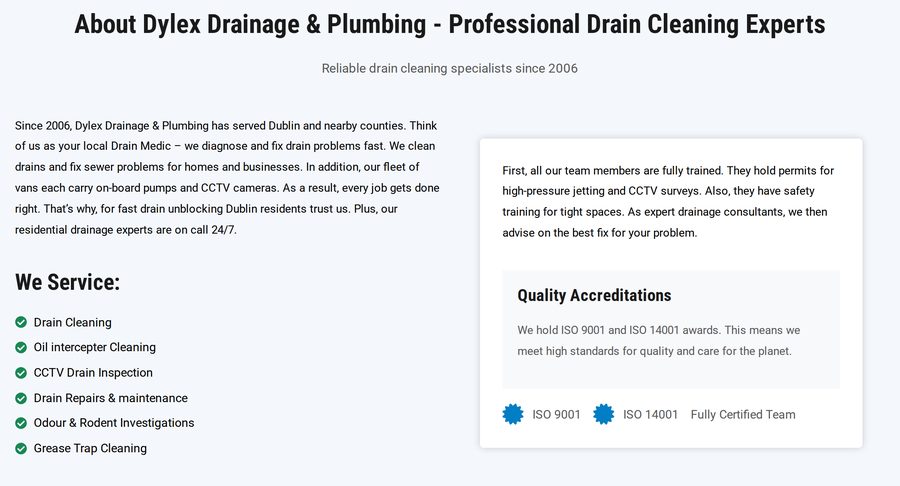
The old menu had an About item, but it was not a page. It was a link to a section further down the homepage, 649 pixels tall, that opened with the line "About Dylex Drainage & Plumbing - Professional Drain Cleaning Experts" and then listed the services again.
For a business that has been trading since 2006 and holds two ISO certifications, that is a lot left unsaid. Customers checking whether a company is real do look for this, and so does Google.
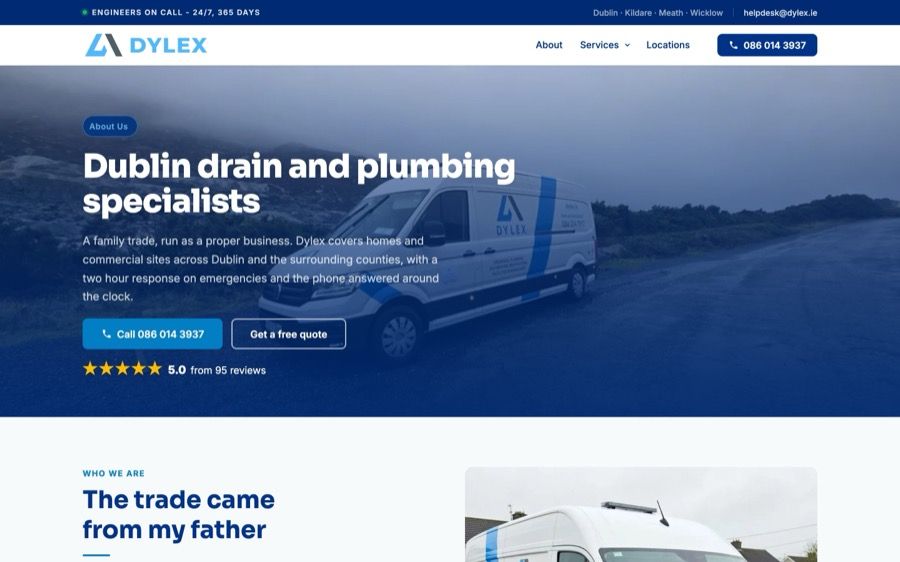
The new about page runs to 7,507 pixels and answers the questions a customer is actually weighing up. Where the trade came from. What is on the van and what each tool is for. What the company guarantees in writing, including the ISO certifications, RGI registration, insurance and a five year guarantee on civil works. What a job costs and what can push that up. It reads like a person explaining the business, not a paragraph written to fill a gap.
About, Desktop
Before
After
A footer that stops shouting
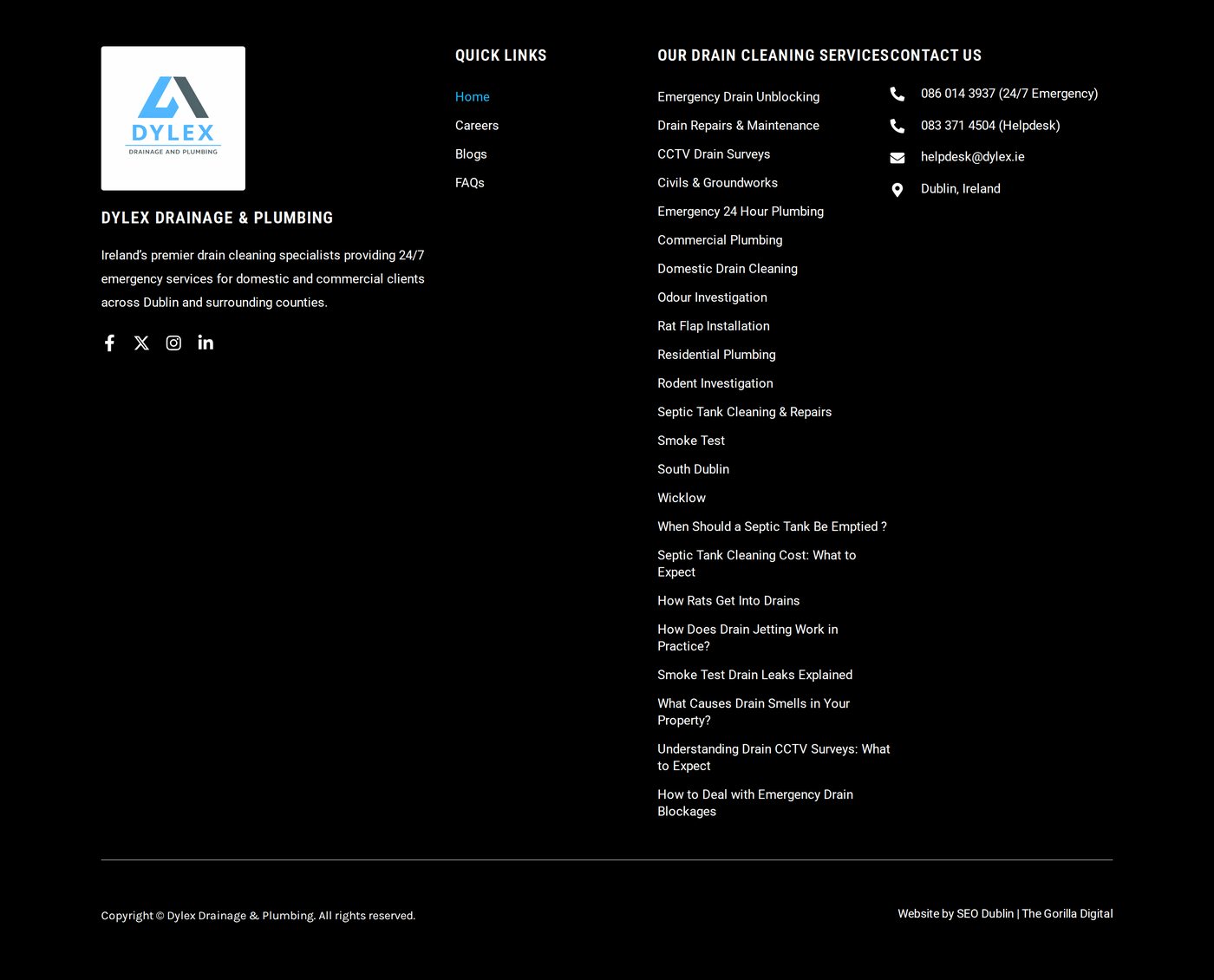
The old footer had a single column of 23 links that ran services, service areas and blog posts together in one list, in text small enough that nobody was ever going to use it.
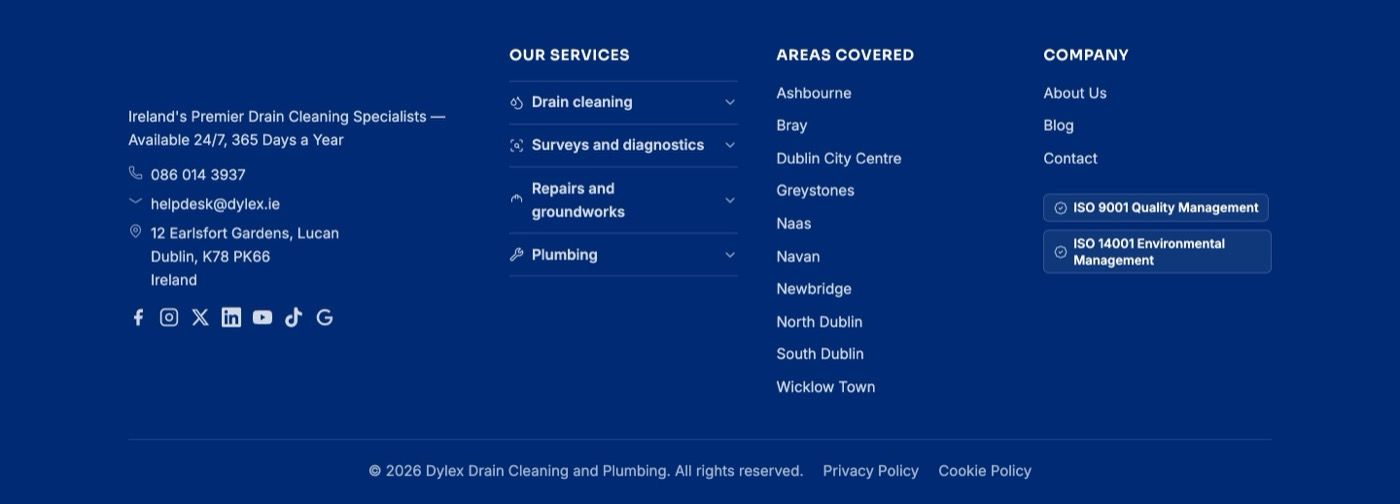
The new one has four groups: contact details, services, areas covered, and company. A footer is a safety net, not a second website.
Footer, Desktop
Before
After
Speed
The site is built with Astro and hosted on Vercel, with the content in a CMS the Dylex team can edit. Every page is delivered as finished HTML rather than assembled in the visitor's browser.
In lab testing on 16 August 2026, Lighthouse scored the homepage 100 for performance, accessibility, best practices and SEO on desktop. On mobile, accessibility, best practices and SEO also scored 100, and performance scored 99, taken as the median of five runs. The largest piece of content on the page appeared in 0.6 seconds on desktop and 2.1 seconds on mobile. On the old WordPress homepage the same measurement was 11.6 seconds on mobile, recorded on 31 July 2026.
Lighthouse, dylex.ie homepage, mobile
Before, WordPress
31 Jul 2026
- Largest Contentful Paint
- 11,644 ms
- Speed Index
- 5,335 ms
- Total Blocking Time
- 188 ms
- Cumulative Layout Shift
- 0.0124
After, Astro
16 Aug 2026
- Largest Contentful Paint
- 2,101 ms
- Speed Index
- 1,102 ms
- Total Blocking Time
- 12 ms
- Cumulative Layout Shift
- 0.0007
Before
11.6s
to draw the main content on a phone
After
2.1s
median of five runs, same phone profile
How these were measured
Before figures come from the LeadVine audit of the old WordPress site on 31 July 2026. After figures are the median of five runs taken on 16 August 2026, spaced roughly three minutes apart so each one cleared the PageSpeed cache.
Both panels are mobile, so the comparison is like for like. dylex.ie began serving the new build on 13 August 2026, which means the old figures can never be taken again.
Two honest caveats. Lighthouse is a lab measurement taken under controlled conditions, not a record of what real visitors experienced. And Google ranks on field data gathered from real Chrome users, which needs roughly 28 days of traffic before it appears in Search Console. The lab numbers are a good sign. They are not yet a result.
Keeping the rankings they already had
A rebuild is the most common way a trade business quietly loses the search rankings it spent years building. It usually happens the same way. New site, new URLs, old addresses left to return a 404, and the rankings attached to those addresses go with them.
We audited all 50 addresses on the old site against the new one. None of them are broken.
Twenty seven kept their exact address, including 17 of the 19 service pages. A customer who bookmarked the CCTV survey page still lands on the CCTV survey page. The other 23 are redirected, which tells Google where the content moved to rather than leaving it to guess. The old WordPress admin paths are closed off.
That is not a growth tactic. It is the work that stops a rebuild from costing the client the ground they already hold.
What the audit found, and what it looks like now
Before the rebuild we ran the same site audit we run on any prospect. It crawled 36 pages on 31 July 2026 and wrote down what it found. That record is worth something now, because it lists problems nobody had reported, and it gives a fixed point to measure the new site against.
The old site had no privacy policy, no cookie policy and no cookie consent of any kind. It also published no postal address anywhere. For a business that sends engineers into people's homes, the missing address is the one that costs you work, because a customer deciding whether a company is real goes looking for it. The new site has a privacy policy, a cookie policy, a consent banner, and a full address with an eircode in its structured data.
Nothing on the old site was set up for sharing. No Open Graph tags, no preview image, no Twitter card. Paste a link to it into WhatsApp or Facebook and you got a bare address with no title and no picture. The new site sets all of them.
The audit also found a broken link to a North Dublin page sitting on the residential plumbing page, an XML sitemap that listed nothing at all, and no HSTS security header. All three are fixed. The sitemap now lists 55 addresses, the North Dublin link resolves, and the site sends HSTS.
Two accessibility checks failed on the old site. Text that did not have enough contrast against what sat behind it, and links with no name a screen reader could read out. Both pass now.
Audit checks, 31 July 2026 against 16 August 2026
17 fixed1 still open
- Fixed: Privacy policy
- Fixed: Cookie policy
- Fixed: Cookie consent banner
- Fixed: Postal address published
- Fixed: Eircode published
- Fixed: Open Graph tags for sharing
- Fixed: Social preview image
- Fixed: Twitter card
- Fixed: HSTS security header
- Fixed: Broken North Dublin link
- Fixed: XML sitemap
- Fixed: Text contrast
- Fixed: Links a screen reader can read
- Still open: Terms page
- Fixed: Company or business name registration published
- Fixed: X-Frame-Options header
- Fixed: X-Content-Type-Options header
- Fixed: Content-Security-Policy header
One check is still open and it is on the list, not left off the end.
The Google Business Profile
Most people looking for an emergency drain unblock never reach a website. They tap the map. So the listing got the same treatment as the site.
We wrote a full specification for it, section by section, on top of research into the four nearest competitors and what people in Dublin actually search for. Twenty services, checked against keyword demand, of which nineteen have measurable monthly volume. Twenty towns in the service area. Five featured items with prices. Eight questions and answers. A brief for fourteen photographs. Fifteen directories where the name, address and phone number have to match.
The Google Business Profile specification we wrote, 12 sections
12 fixed
- Fixed: Your business details
- Fixed: Business categories
- Fixed: Services
- Fixed: Business description
- Fixed: Opening hours
- Fixed: Photo plan
- Fixed: Business highlights
- Fixed: Service area
- Fixed: Featured services
- Fixed: Booking and contact
- Fixed: Questions and answers
- Fixed: Business listings and NAP consistency
Written and handed over. These are the sections of the specification. They are not a claim about what is on the live listing today.
As of 16 August 2026 the live listing carries the 24 hour opening times and none of the rest of that list, so none of it is claimed as done here. Applying it to the listing is the next job and this page will say so when it has happened, not before.
Google Ads
The Google Ads account was not new. Over the 24 months to 3 August 2026 it spent 3,643 euro across 7,290 clicks and recorded 96 conversions, at an average cost per click of 50 cent. When we picked it up, every campaign was paused.
The owner had paused it himself, and he was right to. He was getting calls from Galway. A Lucan drainage business does not service Galway, so those were not cheap leads, they were paid for and unusable. The 50 cent cost per click was the same story from the other end: that is the price of broad national inventory, not a bargain.
The second problem was that nobody could tell what was working. 95 of the 96 conversions were calls placed from the ad itself. There was no call tracking on the website, so anyone who clicked through, read a page and then rang was invisible. No form submission has ever been recorded on the account in 24 months. That makes the 37.94 euro cost per call in the reporting a ceiling rather than a measurement, and it is the wrong number to make decisions with.
Third, the budget was pointed at the weakest campaign. Performance Max Drains took 2,725 clicks and turned 0.59 percent of them into a call. The Plumber Dublin search campaign converted 1.67 percent. Drain Unblocking was costing 61.91 euro per lead against 29.91 euro on Plumber Dublin.
That is what the audit of 10 August 2026 found in the account, as the owner had been running it. Nine things, and they are problems we found, not jobs we have left undone. The campaigns are still paused, so all of them still stand apart from the last one.
- Geographic targeting was paying for calls outside the service area.
- No form conversion had ever been recorded, in 24 months.
- Daily spend was running to about double the 15 euro daily budget.
- There were no negative keywords for out of area searches.
- Conversion actions were not visible, so they could not be checked.
- Performance Max was converting at 0.59 percent against 1.67 percent on search.
- Ads pointed at the homepage instead of a page about what was searched for.
- There was no campaign for bathroom renovations, the highest value job.
- There was no call tracking on the website, so most calls were never counted. This is the one that is now fixed, and the website work fixed it.
What the rebuild does about it.
Three search campaigns on a 500 euro monthly budget, with 78 shared negative keywords. Ten of those are place names, Galway among them. The fastest way to stop paying for a call you cannot service is to stop showing the ad to the person who would make it.
Manual cost per click at launch, phrase and exact match only, and no broad match until the search terms report has 60 days behind it. Automated bidding learns from conversion data, and this account did not have conversion data worth learning from.
The website call tracking had to come first, and it is now live. That is what closes the measurement gap above: a call that starts on a page can be attributed to the page, the search and the campaign that produced it, rather than only counting the people who rang straight from the ad.
The campaigns are still off. They go back on when the landing pages and the conversion actions are in place. What that spend then does is the thing this page cannot tell you yet, and we will put the numbers here when they exist.
Call tracking, so every call has a source
The site runs dynamic number insertion. When a page loads, the number on screen is replaced with a tracking number, and the call that follows is recorded against the visit that produced it.
Checked on the live homepage on 16 August 2026. All seven tap to call links swapped from the published number to a tracking number. The number inside the structured data is left alone on purpose, so search engines and directories still read the real one and the business listings stay consistent with each other.
Before this, a call was a call. Now a call has a page, a search and a campaign attached to it, which is the only way to say what any of the rest of this is worth.
Printed materials
A door hanger for the street the van is already parked on
An engineer on a job is on that street for half a day. The van is outside, the neighbours can see it, and none of that turns into work on its own. The door hanger is what gets left on the houses either side.

A card that asks for the review while the engineer is still there
Reviews are the thing a drainage business is actually chosen on, and the moment they are easiest to get is the moment the drain starts running again. Asking a week later by text is asking someone who has stopped thinking about it.
So the back of the business card is a review request. The QR code opens the Google review form for the listing directly, so nobody has to find the business first.
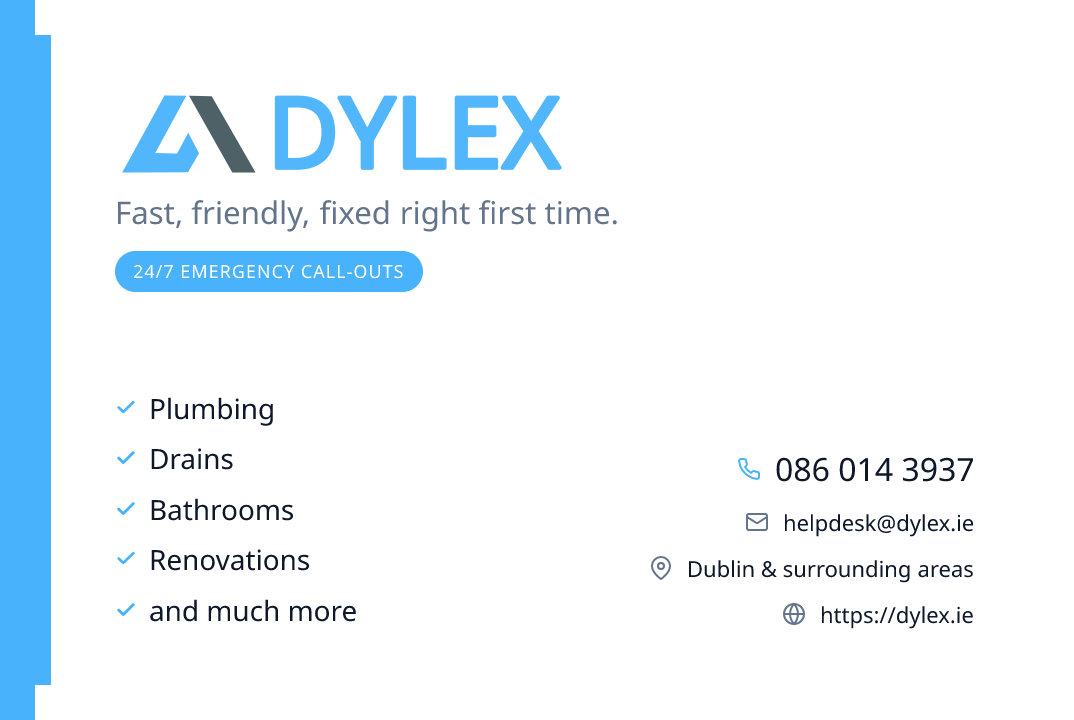
The business card, both sides
Front
Back
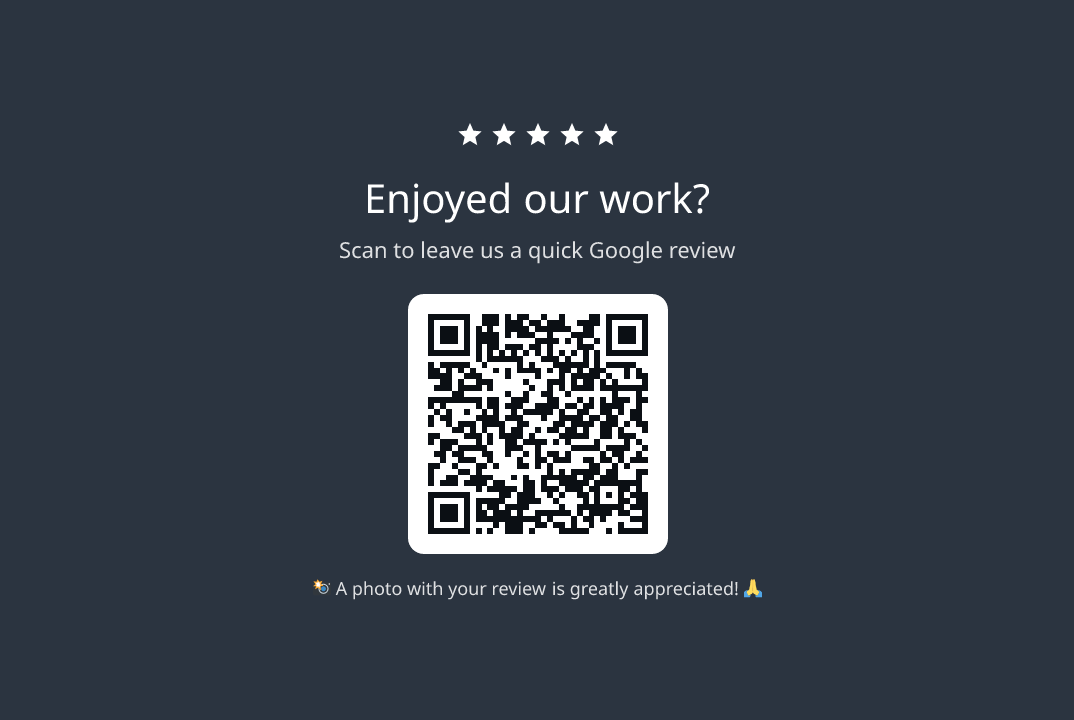
The back sits on the dark navy rather than the brand blue. White on mid blue is a weaker contrast than it looks in a design tool, and the QR code is the one thing on the card that has to scan first time, in the dark, on a doorstep.
What we are measuring next
The site is built and the content is signed off. What we cannot tell you yet is what it did, because it has not been live long enough to have done anything.
Once it is serving real traffic, three things get watched: how quickly the pages perform for actual visitors rather than in a lab, whether the location and service pages start appearing for the searches they were written for, and how many calls and form enquiries come through.
We will update this page with those numbers when they exist rather than before.
What this usually comes down to
If your site is a few years of good intentions stacked on top of each other, the fix is usually not a redesign. It is working out what a customer needs to see in the first ten seconds, and getting everything else out of the way.